
Silent Storytelling: A Thirty-Second Story for America Needs You at Nasdaq
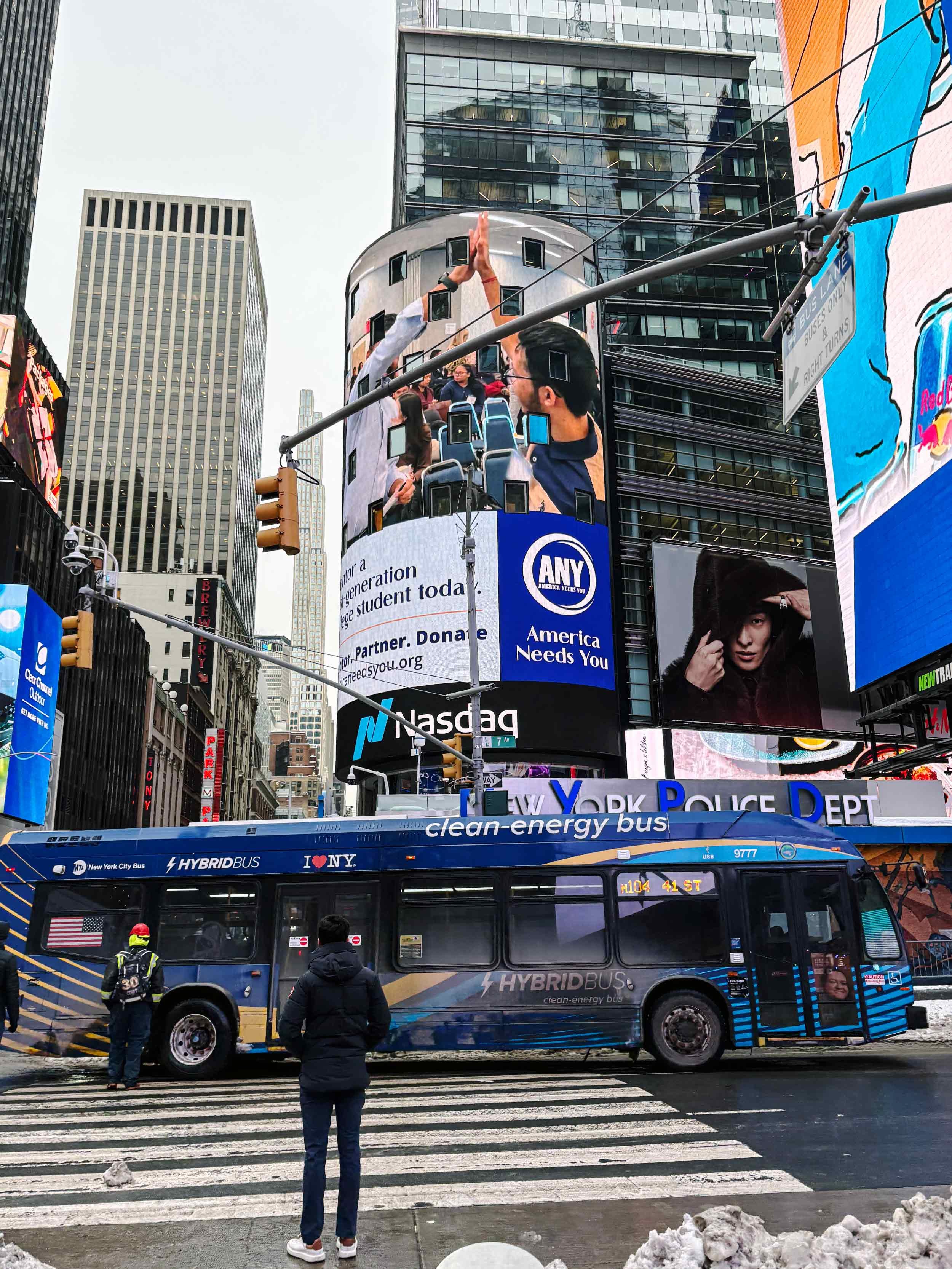
When America Needs You, prepared to ring the Nasdaq Closing Bell during National Mentoring Month, they had a chance to share their story on a screen in Times Square. We were asked to help shape that story through a silent, thirty-second piece about mentorship, confidence, and hope. It was a small project with a big backdrop, and we tried to make the most of it without losing sight of its actual scale.
Every year, first-generation college students step onto campus carrying more than a backpack. They bring hopes, worries, and the quiet pressure of being the first in their families to take this step. Many are figuring out higher education on their own, without parents or relatives who have done it before. They know their goals, but not always how to reach them, or who to ask when things get confusing. America Needs You helps bridge that gap by connecting students with mentors, professional networks, and opportunities that make the transition from college to career feel a little more achievable.
The brief wasn't simply to make a video. It was to tell a meaningful story in thirty seconds, without sound, on a screen in the middle of a place where no one stops moving.
Someone passing through Times Square might catch only a flicker on their way across the street. A person waiting at a red light could take in the whole loop before the city moves them along. Others might see just the last few seconds.
That shaped how we approached it. Instead of asking how much we could fit into thirty seconds, we asked what someone might feel after watching only part of it. The answer wasn't statistics or program details. We hoped it would be something closer to encouragement, a feeling that stays with you after the specifics fade.
Finding one story inside moments of footage
America Needs You gave us footage from several events, plus a longer two-minute video documenting their work. The material was strong, but it wasn't filmed to tell a single continuous story, let alone one that fit in thirty seconds. So, before any design work, we spent time trying to find the story within it.
Rather than organizing the footage chronologically, we organized it emotionally. We looked for authentic moments: encouragement, relief, nervousness, pride, connection. Small interactions between mentors and students tended to carry more than wide shots of events, and faces said more than graphics. We set aside the slower footage, the corporate imagery, and the statistics, and stayed with the moments that felt human.
The aim wasn't to explain everything America Needs You does. It was to help someone sense why mentorship matters before the screen moved on.
Making every frame count
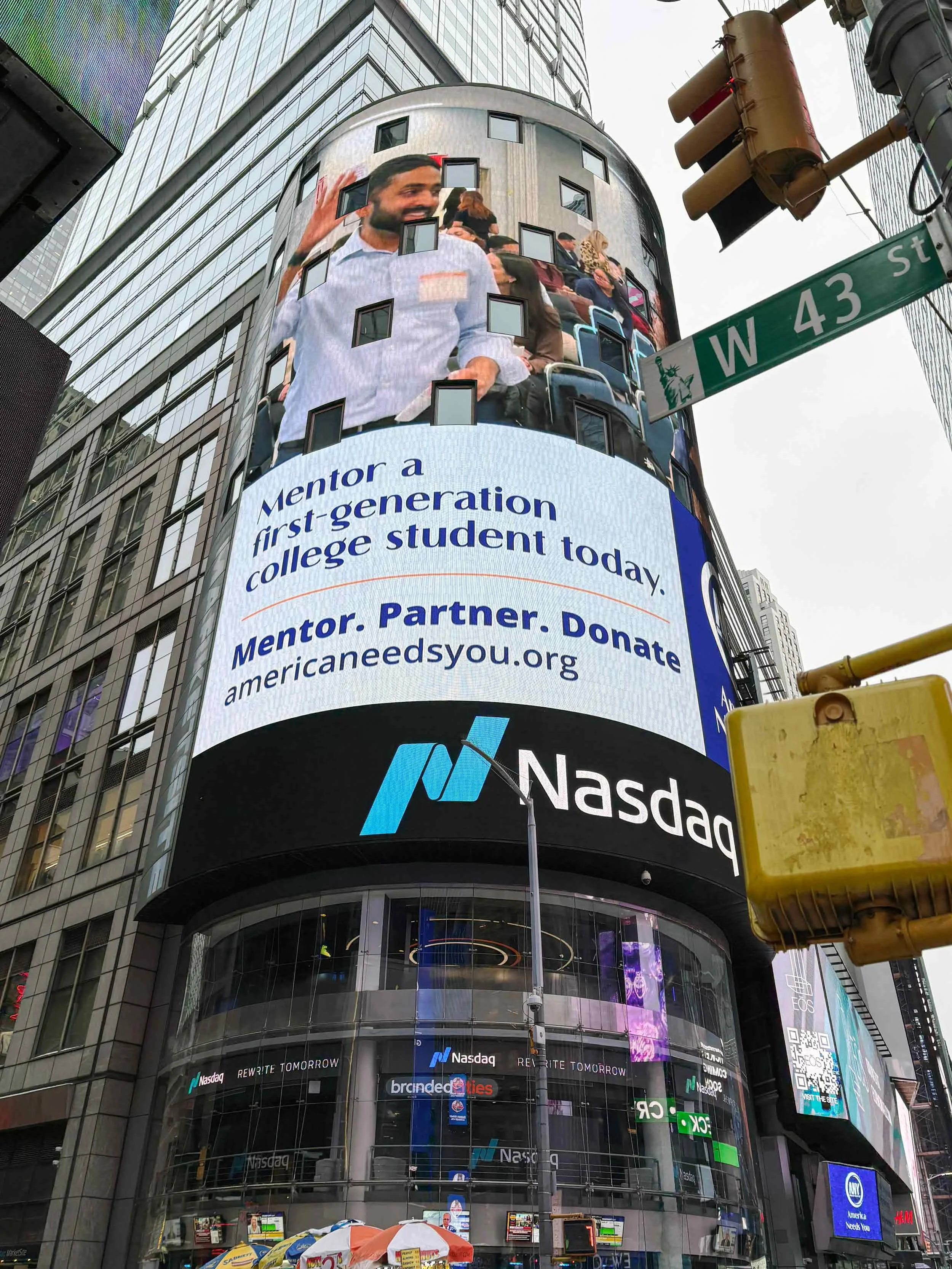
With no narration or music, each edit carried more weight, so we tried to make every frame count. We built the piece around one sequence we kept returning to. A student stands outside a building, preparing for what appears to be an interview. Across the animation, you see the relationships and encouragement that helped get him there. At the end, he pauses, exhales, and walks through the doors.
It's a small gesture, but we hoped it would land. Anyone who's started something new while feeling unsure knows that moment. A first day on campus, a first internship, a first real interview. Confidence rarely shows up on its own; it tends to grow slowly, with the support of someone who believed in you first. That was the feeling we wanted people to leave with.
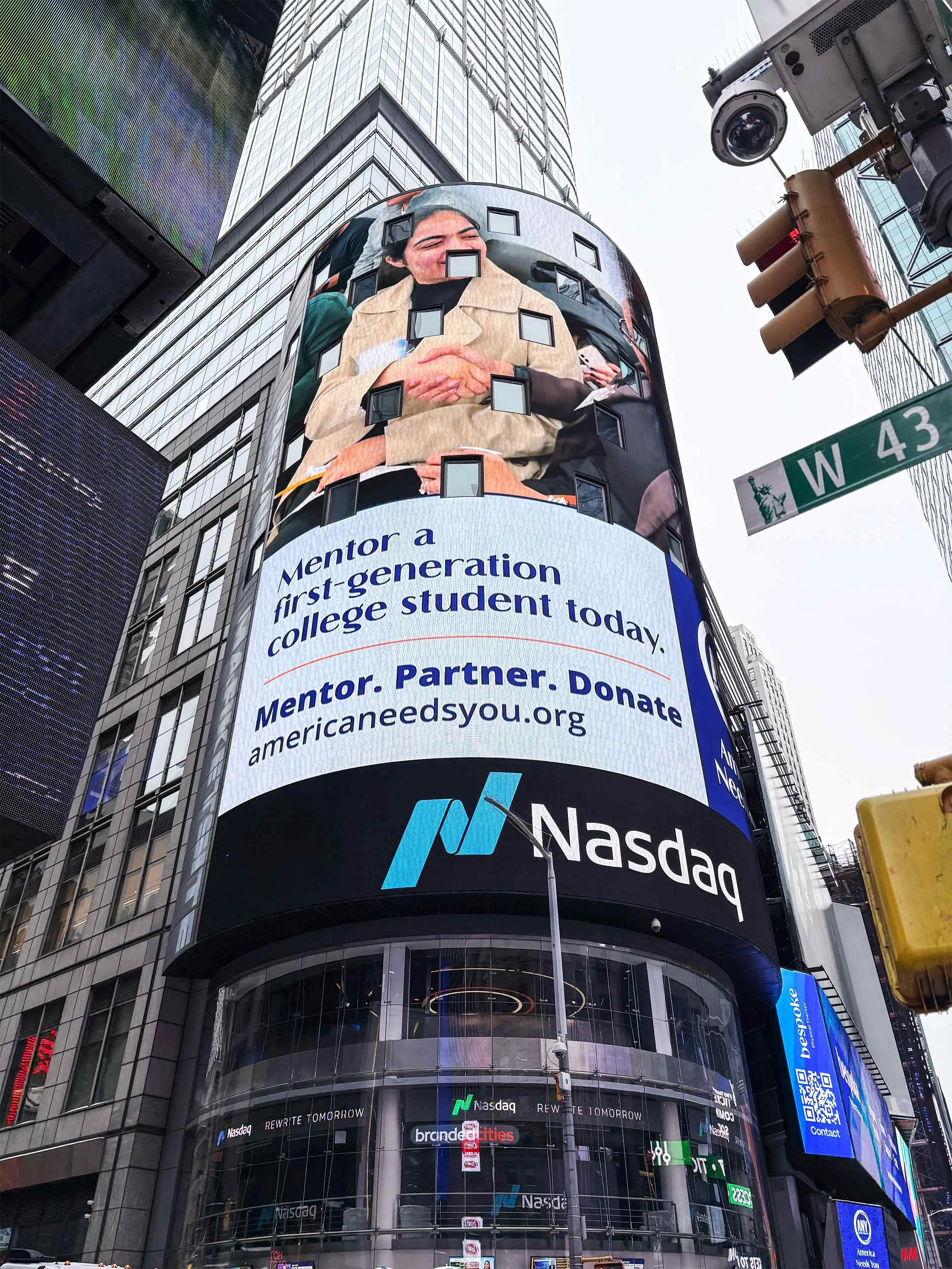
The work went well beyond editing. The Nasdaq tower isn't a flat screen; it curves, and the windows interrupt the display, so every composition had to be planned so that faces and key moments didn't get split across the building's architecture. The source footage came in various formats and aspect ratios, so we carefully cropped, reframed, and sequenced it to ensure everything fit. We blurred name badges to protect privacy. Every shot had to meet Nasdaq's technical requirements while holding the emotional flow.
These aren't details most viewers notice, and that's the point. They're the behind-the-scenes choices that let people focus on the story rather than the production.
A collaborative search for the right feeling
The project came together through conversation. America Needs You shared footage, background, and context, and together we moved from which clips to use toward how the piece might make someone feel. How could thirty silent seconds introduce a mission? How could a single public moment nudge someone to picture themselves as a mentor or as someone worth mentoring? Those conversations shaped the final piece as much as the timeline did.
Looking back, the lesson that stays with us was simple: good footage isn't enough on its own. Most organizations have photos, videos, and highlight reels. What people tend to remember isn't the collection but the story those moments make together. Our job was less about showing off animation and more about finding the story already in the footage, then shaping it to be readable in the time it takes for a traffic light to change.
The moment we’ll remember
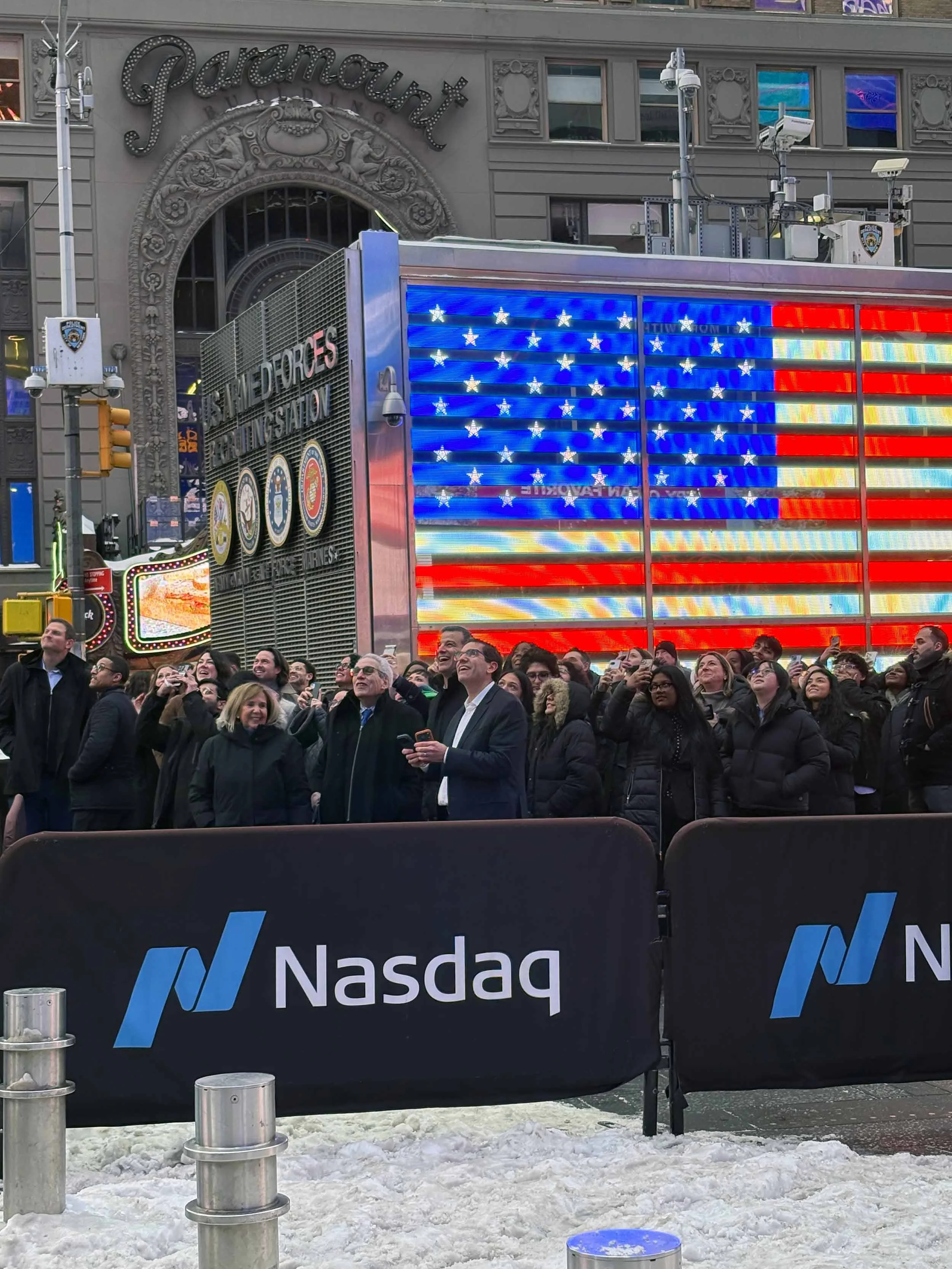
After the animation went live, the America Needs You team gathered outside to watch it fill the tower. As they looked up, their chief communications officer turned toward us, smiled, and silently mouthed two words: "Thank you." For a project about silent storytelling, it was a fitting response.
We don’t know how many people looked up that day, or what they felt. We just hoped a few of them carried something forward and that maybe, for someone, mentorship felt a little more possible than it had a minute before. We each have had mentors or been mentored in our lives without knowing it. There is something holistic and ancestral about learning from those who have walked the path before you. That is what stayed with us: the quiet proof that even a brief, silent story can make mentorship feel close and personal.
What Stayed with Us
Design for the moment, not just the message.
People didn't come to Times Square to watch our video. They were walking to work or waiting at a crosswalk. Designing for that shaped nearly every choice we made, and it sharpened the story for a passing audience.
A story often travels farther than a statistic.
America Needs You has strong outcomes, but what tends to stick is how the work makes someone feel. Let the numbers support the story rather than replace it, so that story is what people carry forward.
Constraints can sharpen the work.
On this project, the limits—silent, thirty seconds, mixed footage, a screen broken up by windows—ended up focusing us more than they held us back, and they clarified what mattered most. Use those limits to define the takeaway more sharply.
Good footage isn’t enough.
The meaningful moments were already on camera. The harder part was finding the story hidden inside them, then making that story clear at a glance.
Every frame should earn its place.
Without narration or music, each expression and transition had to move the story along—a reminder that clarity often comes from what you leave out.
